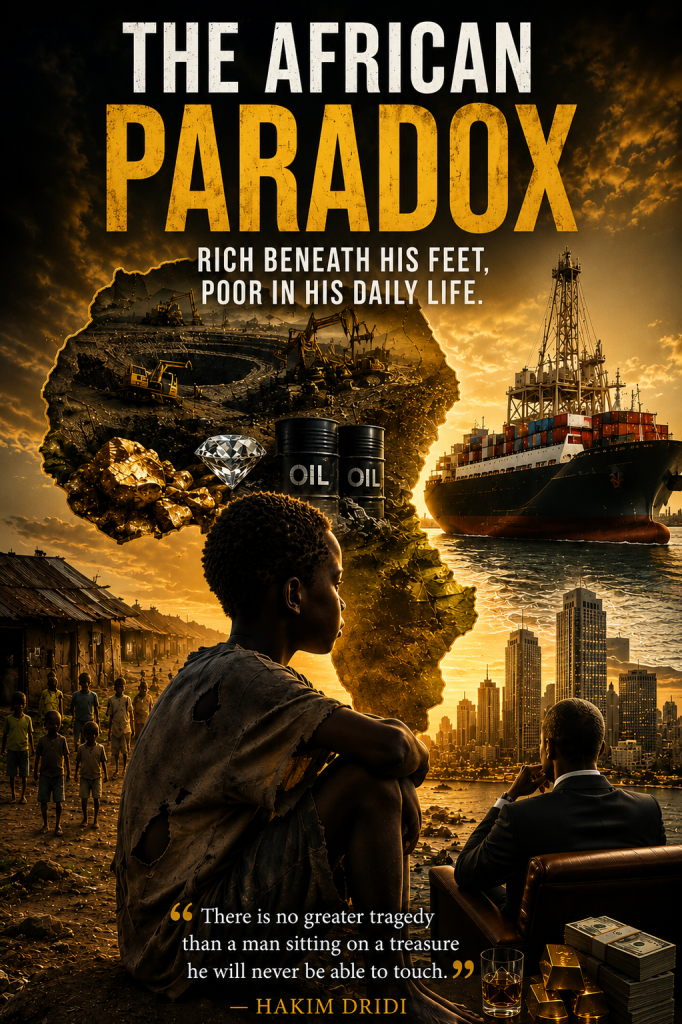
He was born on a land the entire world covets.
Beneath his feet lie gold, diamonds, oil, cobalt, uranium, and countless other resources that great powers have competed for over centuries.
Yet when he returns home, he sometimes wonders how he will feed his family.
That is the paradox.
The richer the soil.
The poorer the man seems.
As if abundance had been granted to the land, but denied to those who live upon it.
Ships leave the ports loaded with treasures.
Figures accumulate in economic reports.
Fortunes are built.
Financial empires prosper.
Yet in the shadow of this wealth, children grow up without access to decent schools.
Families struggle to survive without access to the essentials.
Entire villages still wait for the benefits of what their own land already provides to the rest of the world.
History is sometimes marked by a cruel irony.
The poorest man in the village may live above a wealth that entire nations desire.
And some leaders can earn in a single month what an honest citizen will never earn in a lifetime.
Sometimes not even in a hundred years.
Africa’s tragedy is not that it lacks wealth.
Africa’s tragedy is that it overflows with wealth without that wealth always reaching those who should be its first beneficiaries.
For when a people suffer in the midst of abundance, the question is no longer economic.
It becomes moral.
It becomes philosophical.
It becomes human.
How can a continent capable of feeding the world still struggle to feed all of its children?
How can a land so generous leave so many of its own people in need?
Perhaps true poverty is not the absence of resources.
Perhaps it is the absence of justice.
For there is no more tragic spectacle than a man sitting upon a treasure he will never be allowed to touch.
— Hakim Dridi
In tribute to all peoples who live in poverty amid abundance, and to those who continue to believe that wealth has value only when it benefits those who create it and those to whom it rightfully belongs.